ICRA 2026 Competition: AI for Robotic Surgery
NOTE: This competition concluded on June 4, 2026
Overview
Surgical robotics is entering an exciting new era where the integration of artificial intelligence (AI) promises to improve the performance of human surgeons, and to address the growing shortage of surgeons and other medical personnel, thereby improving healthcare for all.
The most prevalent surgical robot in operating rooms today is the da Vinci Surgical System (Intuitive Surgical, Sunnyvale, CA), which has an installed base of more than 10,000 systems. The competition will use the da Vinci Research Kit (dVRK), an open-source research platform that re-purposes the mechanical hardware from retired clinical da Vinci Surgical Systems, as well as simulators based on this platform.
Challenges
There are two challenges, both using the peg transfer task. In this task, the user picks up a peg from a post (with the non-dominant hand) and transfers it to another post, often with an intervening handoff between the left and right instruments without dropping the peg. This task (originating from the Fundamentals of Laparoscopic Surgery) is widely used in robotic surgery training to improve robotic manipulation skills, but is simple enough that anyone can learn it.
We have increased the task difficulty by introducing a barrier (wall) in between the left and right sides of the pegboard. This barrier, and workspace constraints, make it impossible to perform the task without a handoff between the two instruments.
-
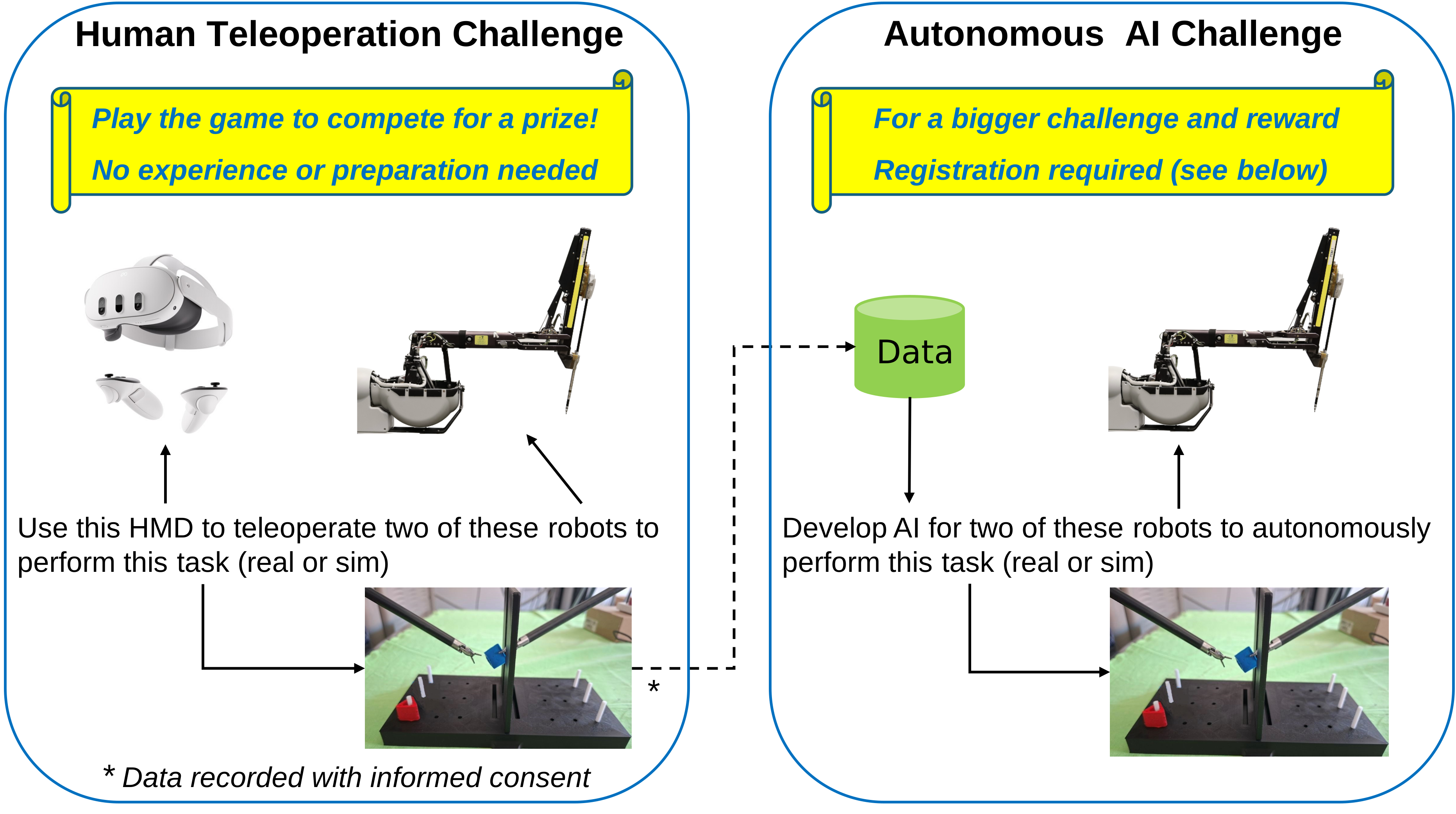
Human teleoperated peg transfer: the competitor uses an input device (Meta Quest 3) to teleoperate a real or simulated dVRK to transfer as many pegs as possible within the time limit.
-
Autonomous peg transfer: the competitor (or team) provides an AI algorithm to move a real or simulated dVRK to transfer as many pegs as possible within the time limit. The algorithm must interface with the real or simulated dVRK using ROS2 (API documented here). Registration is required (link).
During the competition, data recorded from the human teleoperated peg transfer challenge (with informed consent, in accordance with our Privacy Policy) will be uploaded to a server to support development of algorithms for the autonomous peg transfer challenge. The link to the server will be shared with participants who have registered for the autonomous peg transfer challenge.
Environments
We have simulated and physical setups on the competition floor. The intent is for the two setups to be as similar as possible. All setups use Ubuntu 24.04 and ROS 2.
The Patient Side Manipulators (PSMs) and camera will not be intentionally moved (since the camera is in the workspace of the PSMs, it is sometimes inadvertently moved). The camera extrinsics are approximately known, so that the pose of each PSM is given with respect to the camera frame. We will provide the stereo camera intrinsic parameters. The peg board location will not be provided and may be moved during the competition.
Each setup includes a Meta Quest 3 connected to the computer via an Ethernet/USB-C adapter. This tethered configuration was chosen to avoid potential issues with WiFi connections in the exhibit hall, and to allow continuous charging of the devices. For the autonomous competition trials, the Quest 3 can be disconnected, if requested.
Following are details about the three different environments:
- AMBF Simulation Setup
- Isaac Sim Setup – for demonstration only
- Physical dVRK Setup
Competition Rules and Assessment
- See this page
News
November 16, 2025: Website created
May 21, 2026: Please register for the Autonomous Competition using this form (do not register if you will only participate in the Human Teleoperated Competition)
May 30, 2026: Added overview figure, and more details about competition
June 3, 2026: Allow autonomous algorithms on dVRK to use two red pegs; minor rules change (allow trial to continue if one peg falls outside workspace); IsaacSim setup for demonstration only (no competitions on this platform)
June 17, 2026: Competition winners posted on website
Timeline
Tues, June 2, 2026: Human teleoperation competition (9 AM - 6 PM)
Wed, June 3, 2026: Human teleoperation and autonomous competition (9 AM - 6 PM)
Thurs, June 4, 2026: Autonomous competition (9 AM - 4 PM), Award ceremony, 4:45 PM (Hall C5)
Registration (ICRA and Competition)
All competitors must be registered for ICRA. In addition, teams interested in the Autonomous competition register for the challenge, using this form. Registration will give access to the calendar for scheduling time to test your algorithm on the physical or simulated system.
The Human Teleoperation challenge is only open to individuals (not teams) and there is no registration for the challenge–just show up and give it your best!
If you would like to participate in any of the challenges, but are not registered for ICRA, a ‘competition only’ registration rate may be available (please contact us to check).
Awards
The top performers in the following categories will receive prizes (in Euros) and a certificate at the awards ceremony:
| Competition | 1st place | 2nd place | 3rd place | Total |
|---|---|---|---|---|
| Human Teleoperation, AMBF Sim | 125 | 50 | 25 | 200 |
| Human Teleoperation, Isaac Sim | — | – | – | — |
| Human Teleoperation, Real | 250 | 100 | 50 | 400 |
| Autonomous AI, AMBF Sim | 300 | 150 | 50 | 500 |
| Autonomous AI, Isaac Sim | — | — | – | — |
| Autonomous AI, Real | 600 | 300 | 100 | 1000 |
| TOTAL | 2100 |
The prizes will be given as Virtual Visa gift cards, a few weeks after the conclusion of the competition.
Competition Winners
Human Teleoperation Challenge
Following are the winners of the Human Teleoperation challenge, out of a total of 18 participants in the AMBF Sim challenge and 21 participants in the dVRK (Real) challenge:
| Competition | 1st place | 2nd place | 3rd place |
|---|---|---|---|
| Human Teleoperation, AMBF Sim | Britton Jordan | Minho Hwang | Ryan Yeung |
| Human Teleoperation, Real | Seongjun Park | Ryan Yeung | Cholin Kim |
Autonomous AI Challenge
Five teams registered for the Autonomous AI challenge, which was much more difficult due to the limited time for development. One team was able to demonstrate an autonomous peg transfer on the Real dVRK at the conclusion of the challenge.
The first place award in the Autonomous AI, Real challenge goes to Team SurGLab from DGIST, South Korea. The team members are: Cholin Kim, Jeonghyeon Yoon, Seongjun Park, Sihyeoung Park, Jonghyun Kang, and Minho Hwang.
Contact
To contact the organizers by email: accelnet-robotics-challenge-admin@googlegroups.com
Organizers
| Peter Kazanzides, Adnan Munawar | Loris Fichera |
| Johns Hopkins University | Worcester Polytechnic Institute |
| Tamás Haidegger | Thomas Looi |
| Obuda University | Hospital for Sick Children, |
| University of Toronto |
Acknowledgments
 Development of this Surgical Robotics Challenge is supported by the United States National Science Foundation (NSF)
via OISE-1927354 and OISE-1927275, AccelNet: International Collaboration to Accelerate Research in Robotic Surgery.
Development of this Surgical Robotics Challenge is supported by the United States National Science Foundation (NSF)
via OISE-1927354 and OISE-1927275, AccelNet: International Collaboration to Accelerate Research in Robotic Surgery.